 ParaCrux
Case study · From the lab · 29 September 2026
A play tower, checked against the standard. Then redesigned and checked again.
We gave an AI agent a SOLIDWORKS model of a children's garden play tower and one brief: review it for the UK domestic market. It found 19 failures, built a new design and checked it again. It also wrote down everything it couldn't check.
Lab work. Design review is not yet a feature of the Agent you can buy. This page says which is which.
THE BRIEF
“Review this tower for the UK domestic market, then fix what fails.”What it found in the original.
Every finding comes with the measured value, the limit and the clause. These five matter most for a child.
- FAIL · DESIGN ATwo sides of a 1.6 m platform had no barrier.
BS EN 71-8 asks for a barrier at least 600 mm high on every outward side of a platform 1 m or more above the ground.
- FAIL · DESIGN AThe ladder rungs were 100 mm logs.
Rungs should be 16–45 mm across. Three gaps above 600 mm measured 180 mm, inside the band where a child's head can pass but not come back.
- FAIL · DESIGN AThe swing beam pointed the wrong way.
Hung from that beam, a trapeze or rope swings towards the posts and hits them after about 21°.
- FAIL · DESIGN AIt tipped over unless anchored.
One 50 kg child swinging outwards overturns it. Four permanent ground anchors are needed, each good for about 2.1 kN.
- FAIL · DESIGN AThe top of the wall was a 2.8 m seat.
Nothing a child can climb, sit or stand on may be above 2.5 m. The wall's top rail sat 1.2 m above the deck, within reach.
Watch the review.
Real SOLIDWORKS footage and the real report. Narrated by Tom, with optional English captions. Jump to any step.
How the review ran.
Six steps, each producing a file you can open, check and rerun.
- 01
Read the model
It opened a copy, never the original, and measured every body: posts, rails, rungs, deck boards and wall boards. It found 30 overlapping solids where the joints had never been modelled.
- 02
Check the standard
It ran 20 rules from BS EN 71-8. Each rule carries its clause and says where its limit came from: the designated 2018 edition, the older 2011 text, or engineering judgement.
- 03
Run the hand calcs
It ran 18 Eurocode 5 checks with the UK National Annex, for C16 treated pine, including the loads EN 71-8 uses in its tests. Every load lists its source.
- 04
Remodel, as a new file
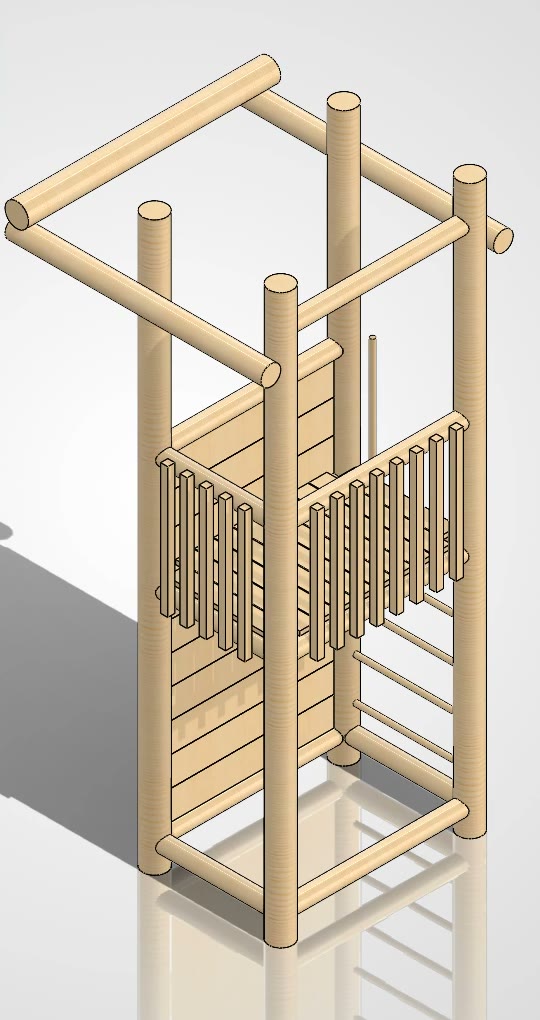
It derived each new dimension from a rule limit, then built design B in SOLIDWORKS member by member. The joints are housed, and every body is named by its job.
- 05
Check the new model
It measured design B from the new model, not from its own proposal, and ran every rule and calc again.
- 06
Write it up
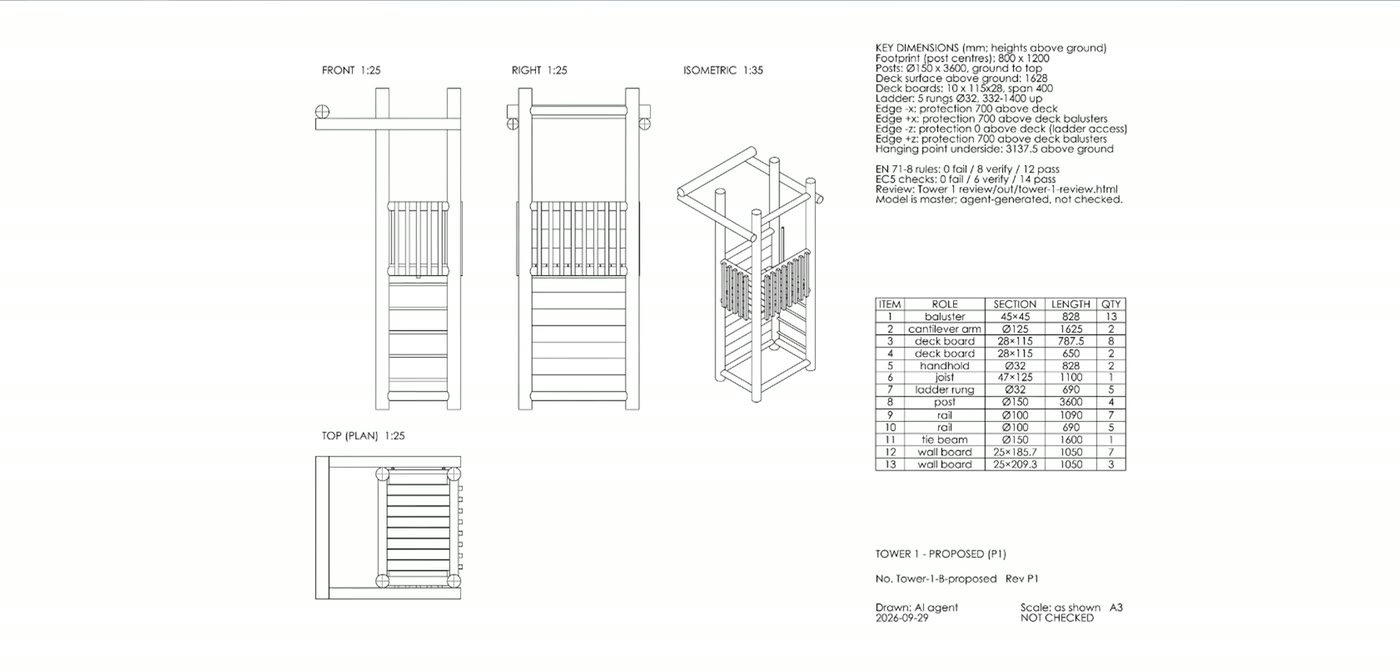
It produced a GA drawing, STEP file, cut list and hashed manifest for each design, plus the review report that compares them.
Design A against design B.
Both columns are measured from a SOLIDWORKS model. Design B's numbers come from the rebuilt part, not from the proposal text.
| A · as modelled | B · proposed | |
|---|---|---|
| EN 71-8 rules: fail / verify / pass | 8 / 6 / 6 | 0 / 8 / 12 |
| Eurocode 5 checks: fail / verify / pass | 11 / 0 / 7 | 0 / 6 / 14 |
| Barrier above the deck (+x / +z) | none | 700 mm, 45 mm balusters |
| Ladder rungs | Ø100, 180 mm gaps | Ø32, 235 mm gaps |
| Deck board span | 800 mm | 400 mm, centre joist |
| Cantilever arms | Ø100 through the posts | Ø125 bolted to the post faces |
| Ground anchors | none | 4, permanently fixed |
| Overlapping solids | 30 | 0 |
It said what it couldn't check.
Design B has no failures. It still has 14 “verify” items, because the model cannot show them: fasteners, timber treatment, warning labels, the rope specification, anchor pull-out and the bolted joint design.
- A rule quoting the older 2011 text is marked “superseded” until someone checks it against a licensed 2018 copy.
- A rule built on judgement, such as how far a trapeze swings, can never score better than “verify”.
- A result that depends on a guessed member role or intent stays at “verify” until an engineer confirms it.
- Every assumption is listed: the ground plane, timber grade and density, user mass, the height of the swing element and how high a child can climb.
Prepared, not certified
The agent prepares. Your engineer verifies and decides. Every output says it was prepared by an AI agent and has not been checked. A children's product must be verified by a competent person before it is made or sold. Adopting any change is your decision and your responsibility.
Read section 5 of the termsWhat ships today, and what's still in the lab.
If it isn't in the left column, you can't buy it yet.
Available In the Agent today
- Inspect features, dimensions, configurations and properties of the open model
- Propose dimension changes that you review in a worksheet before anything runs
- Run changes on copies and check the native and STEP outputs; your original is kept
Lab Not yet for sale
- Standards rule sets with a source on every rule, and checks run against your model
- Hand calcs that go stale when the model changes
- Remodelling from reviewed proposals, with drawing packs and hashed manifests
Which of your products would you want reviewed first?
Tell us the product type and the standards you design to. We'll tell you plainly whether it's close, a long way off, or something we won't do.
Please don't attach confidential models. If there's a fit, we'll arrange a proper channel.