 ParaCrux
From the lab · Recorded 29 September 2026
Change one dimension. The drawing follows.
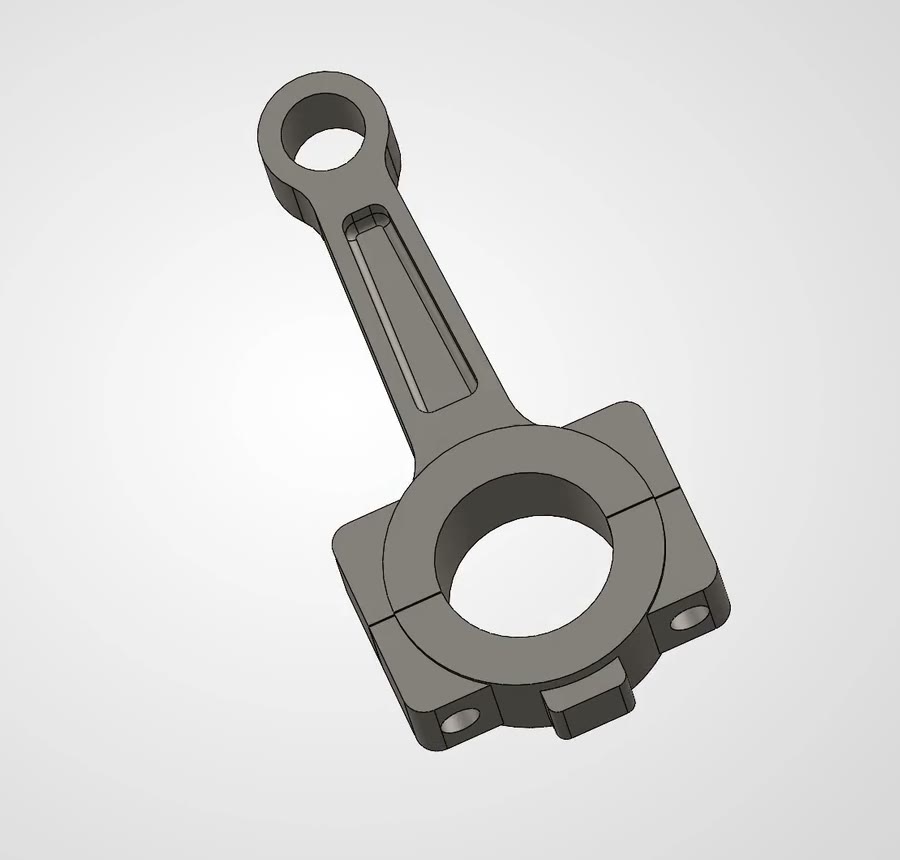
We asked an AI agent to model a connecting rod in SOLIDWORKS with every sketch fully defined, draw it on an A3 ISO sheet, then make an engineering change. It moved the centre distance from 110 to 120. The part rebuilt and the drawing followed to revision B.
This is lab work, not yet a product feature. Everything on this page says which is which.
THE BRIEF
“Model it with fully defined sketches, draw it on our A3 sheet, then change CC to 120.”It seems the first model is rarely the hard part.
It's the change after. One dimension moves, and someone has to check every feature that hung off it, then every view, note, weight and revision on the drawing.
Feature tree, as the agent named it
- BIG-ENDØ60 × 22
- SMALL-ENDØ28 × 18, at CC 110follows CC
- SHANK24 → 17 wide × 18follows CC
- BOLT-BOSSES19 × 48 × 20, both sides
- BALANCE-PAD18 × 11 × 14
- BLEND-BIG-ENDR14
- BLEND-SMALL-ENDR10
- BOSS-CORNERSR5
- PAD-CORNERSR2.5
- BIG-END-BOREØ38 H6
- SMALL-END-BOREØ18 H7follows CC
- POCKETSthrough, 4 in from each flankfollows CC
- WEB5 thickfollows CC
- POCKET-CORNERSR3, both sides
- POCKET-FLOORSR2, both sides
- M8 CBOREHole Wizard: Ø9 thru, ⌴ Ø15 ↧ 8.6
- MIRROR M8 CBOREabout the Right Plane
- OIL-HOLEØ3 into the small endfollows CC
- SPLIT-LINErod and cap, two bodies
- CR-110 drawingA3 ISO, fits, notes, rev A
- Change: CC 110 → 120part and drawing rebuild to rev Brev B
Names and values from the part's own feature tree. “Follows CC” marks the features an equation ties to the centre distance; the last row is the recorded change.
Watch the whole thing.
Three minutes and seventeen seconds, narrated by Tom, with optional English captions. Jump to any stage of the build, the drawing or the change.
One drawing. Two bracket revisions.
Tom walks through a complete lab build in one minute and forty-two seconds: extrusions, fillets, gussets, Hole Wizard holes and patterns. The agent preserves the original, widens a separate copy, enlarges its bore, and creates a drawing for each revision with dimensions and model properties.
Then a V8. Then a bigger one.
Recorded 30 September 2026, in the same lab. The agent built a 3.5 litre V8 rotating assembly around the CR-110 rod: crankshaft, pistons, pins and shells, each driven by named variables, mated into eight cylinders and drawn with a parts list. Then it copied the design and changed only those variables, stroke, bore and the rod's centre distance, to make it 5.0 litres.
- Measured, not asserted. Stroke and bore were read back from the model: 3.5033 L, then 5.0027 L, the same as the hand calculation.
- One mate turns the engine. Checked at 11 crank angles: every piston where the maths puts it, and no interferences.
- The copy kept the intent. Shells, washers, circlips and fasteners are shared; the 85 mates re-solved without edits.
- Drawn for both sizes. A GA with its parts list, and crankshaft, rod and piston drawings, as a pack for each.
Then a whole drone, from a written brief.
Recorded 1 October 2026. ScoutCrux 500 is a folding camera drone: 29 parts and 112 components, sized by hand calculation, built and checked in SOLIDWORKS, drawn, and opened in ParaCrux. Then the brief changed to 650 mm, and the agent changed the design through its parameters, refusing a tube, a motor pattern and a battery that did not fit.
- Failures shown, not hidden. The first check found clashes and an overweight structure; fixes were made in the model and checked again.
- Catalogue, not scaling. Tube, motor, propeller and battery were chosen from discrete options against the requirements.
- One requirement fails honestly. Folded, the 650 is too long for the original case, and the record says so.
Then an underwater ROV, built to a feature standard.
TideCrux 100 is a harbour-inspection ROV rated to 100 m. The agent modelled it in SOLIDWORKS against a written modelling standard: fully defined sketches with named dimensions and no Fixed relations, Hole Wizard holes, patterns and mirrors, a bent-tube sweep with its bend table, and sheet metal. Then it audited every part and checked the assembly for interference, mass and buoyancy.
- An audit that has to catch something. A deliberately bad part is checked alongside the real ones; the audit must flag it.
- ParaCrux libraries, not one-offs. Global Standard fasteners, materials, appearances and profiles, with parts reused from a cache.
- A change by catalogue. At 300 m the housing goes to Sch 40, the dome to 10 mm and the foam to a deep grade, and a gripper is added.
Before you ask.
You've seen AI demos before. You're probably thinking at least one of these. You'd be right to.
- “It's a cherry-picked demo.”
- It's one recording of one part, and we won't pretend otherwise. Before we call any part family automated, we'll measure it on parts the agent has never seen and publish the result. Tell us which families you'd test it on.
- “It won't hold design intent.”
- That's why every sketch had to be fully defined, and why the centre distance is one named dimension, CC, that equations tie to the small end, shank, pockets, web and oil hole. The change in the recording is the test: nothing on the sheet was edited by hand.
- “Checking it will take longer than drawing it.”
- On some parts, maybe. Every feature is named for what it is and the title block says the sheet has not been checked, so you know where to start. Only your parts can settle it.
- “Our drawings can't leave the building.”
- Understood. The shipping Agent runs on your workstation with your own SOLIDWORKS licence, and model files are not uploaded. See exactly what is sent
- “Can I buy this today?”
- Not this part of it. Building parts and drawings like this is lab work. The Agent you can buy today inspects models and makes reviewed changes on copies. What ships today
Thursday, 16:40.
The request
A customer email lands: “We need the rod 10 mm longer. Can you send revised drawings by Monday?”
The way you know
Open the part, find the sketch, change it, and hope the pockets and the oil hole follow. Then the drawing: views, dimensions, weight, revision, title block. On Tuesday someone finds the view you didn't update.
The way we're building
You write one sentence. The agent changes the named dimension, rebuilds and checks the model, and brings the drawing to the next revision with its new weight. It tells you what moved.
Your job changes
You check the revision, starting with what moved. You make the calls that need an engineer. You send the drawings, and you go home.
- Your evening. Carrying the change through becomes the machine's job; the judgement stays yours.
- A drawing that follows the model. Dimensions, weight and revision come from the part, not from retyping.
- Nothing overwritten. The Agent you can buy today already works on copies and keeps your original.
What do changes cost you now?
Three sliders, your numbers. This is the work the lab project is aimed at.
216 hours a year
About 29 working days, or £9,720, spent carrying changes through models and drawings by hand.
Your numbers, multiplied: changes × 12 × hours × rate, at 7.5 hours a day. It is not an estimate of what any software saves.
What ships today, and what's still in the lab.
We would rather under-claim. If it isn't in the left column, you can't buy it yet.
Available In the Agent today
- Inspect features, dimensions, configurations and properties of the open model
- Propose dimension changes that you review in a worksheet before anything runs
- Run changes on copies and check the native and STEP outputs; your original is kept
- Create simple box parts from dimensions you state
- Search the structural profile catalogue and your own design library
- £5 of managed AI credit per seat, every month
Lab Not yet for sale
- Parts built feature by feature with fully defined sketches, as in this recording
- Drawings on your own sheet format, linked to the part's properties
- Engineering changes carried through to the drawing and its revision
- Assemblies mated from the parts' own design intent, and a design copied to a new size by changing its variables, as in the V8 recording
- A typed decision layer that routes each request, running in shadow mode
Would it be a bad idea to tell us which parts you change most?
Name the part family and roughly how many changes a month. No files needed. We'll tell you plainly whether it's close, a long way off, or something we won't do.
Please don't attach confidential drawings. If there's a fit, we'll arrange a proper channel.